How AI agents will change UX, CRO and e-commerce
For more than two decades, we have optimized websites around one fundamental assumption:
The visitor is human.
We studied where people look. Where they click. What makes them hesitate. What builds trust. Which words persuade them. How many steps they tolerate before abandoning a checkout.
We improved visual hierarchy, simplified navigation, added reviews, experimented with scarcity, optimized CTAs and removed friction from funnels.
The entire discipline of Conversion Rate Optimization was built around understanding human behavior and turning more visitors into customers.
But what happens when the visitor making the decision is no longer human?
That is no longer a theoretical question.
AI is moving from answering to acting
AI assistants are rapidly becoming part of the shopping journey.
Consumers can already use AI to research products, compare alternatives, interpret reviews and narrow hundreds of options down to a handful.
The next step is much bigger.
Instead of simply telling you what to buy, AI agents can increasingly help execute the journey itself.
“Find me the best waterproof hiking jacket under €300, suitable for Scandinavian winters, available in my size and deliverable before Friday.”
An AI agent can potentially research the market, compare specifications, eliminate unsuitable products, check availability and present the strongest options.
Eventually, much of that journey may happen without the customer visiting ten different websites.
This shift is already becoming visible across e-commerce. AI-driven shopping traffic is growing rapidly, while platforms and AI companies are developing increasingly sophisticated ways for consumers to discover, compare and evaluate products conversationally.
The traditional customer journey is starting to change.
And that creates a fascinating problem for CRO and UX.
Your website may soon have two different customers
Traditionally, when I optimize an e-commerce experience, I’m thinking about questions such as:
- Can visitors immediately understand the proposition?
- Can they find the right product?
- Do they understand the differences between options?
- Are important USPs visible?
- Is there enough trust?
- Is the CTA noticeable?
- Does the checkout contain unnecessary friction?
Those questions remain important.
Humans aren’t disappearing.
But now we need to add another user to the equation:
The AI agent.
And an AI agent doesn’t experience your website the way a human does.
It doesn’t care that your CTA is orange instead of green.
It doesn’t become emotionally reassured because five stars are displayed next to a product.
It doesn’t get distracted by a rotating hero banner.
And it probably doesn’t care that your product photography won a design award.
Instead, it needs to understand things precisely.
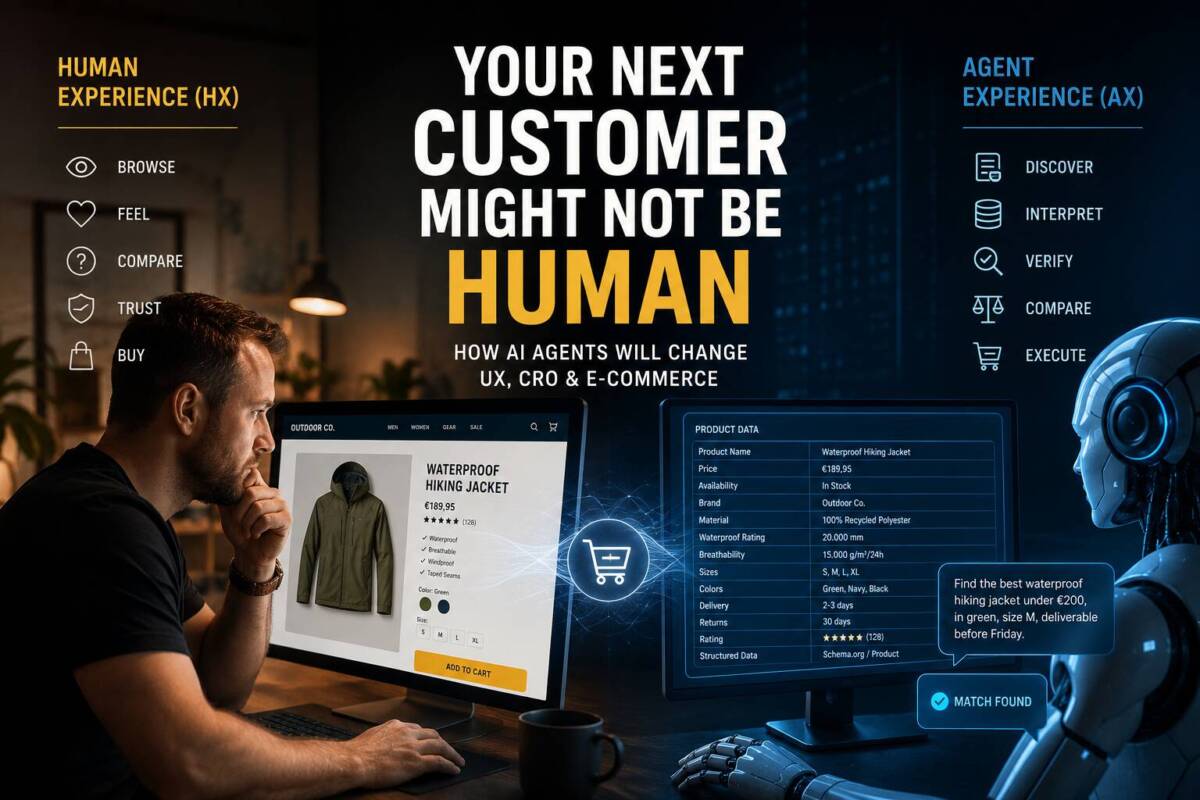
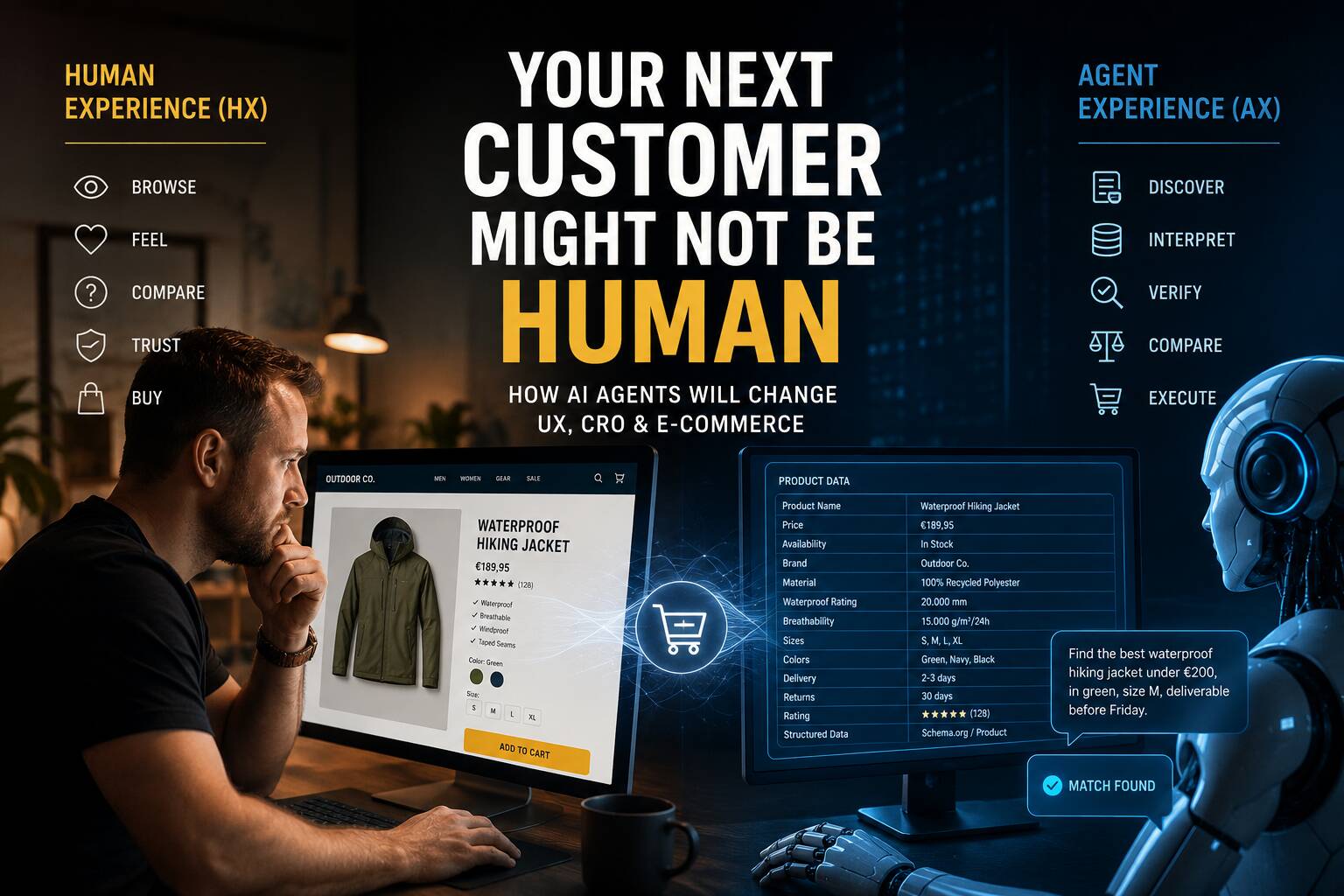
Humans browse. Agents interpret.
Imagine two versions of the same product page.
The first looks beautiful.
Minimal copy. Gorgeous photography. Clever branding. Specifications hidden inside interactive elements. Delivery information appears after selecting several options.
For a human, this could potentially be an excellent experience.
For an AI agent, it could be surprisingly difficult to interpret.
Now imagine another page.
- The product name is explicit.
- Specifications are structured.
- Price and availability are current.
- Variants are clearly defined.
- Shipping conditions are understandable.
- Compatibility is documented.
- Returns are transparent.
- Reviews and product information can be reliably interpreted.
The second page may be considerably easier for an AI agent to evaluate.
That creates an important distinction.
For humans we optimize for:
Attention → Understanding → Trust → Motivation → Action
For AI agents the journey may look more like:
Discovery → Interpretation → Verification → Comparison → Execution
Those are not the same optimization problems.
From UX to HX + AX
This is where I think our definition of user experience needs to expand.
We may increasingly need to think about two parallel experiences.
Human Experience (HX)
How effectively can a human discover, understand, trust and purchase from your business?
This is the world we already know.
UX, CRO, behavioral psychology, usability, persuasion, branding and experimentation all play a role.
Agent Experience (AX)
How effectively can an AI agent discover, interpret, evaluate and interact with your business on behalf of a customer?
That involves a different set of requirements:
- Structured information
- Machine readability
- Semantic clarity
- Accurate inventory
- Transparent pricing
- Reliable product attributes
- Clear policies
- Accessible commerce infrastructure
- Verifiable claims
- Consistent data
Researchers and technology companies are already exploring what it means to make digital experiences more usable by autonomous agents.
So the question for digital teams is changing from:
“Is our website optimized?”
to:
“Optimized for whom?”
The conversion funnel itself could change
For years, e-commerce teams have obsessed over something resembling:
Acquisition → Landing page → Category → Product → Cart → Checkout → Purchase
We measure every step.
We identify drop-offs.
We run experiments.
We improve conversion.
But an AI-mediated journey could increasingly look like:
Intent → AI agent → Product evaluation → Recommendation → Transaction
Several traditional website interactions can disappear from that journey entirely.
A shopper doesn’t necessarily need to navigate your menu.
They don’t necessarily need to use your filters.
They might never see your category page.
They may not read your beautifully optimized homepage.
In some journeys, they might barely interact with your website at all.
This doesn’t mean CRO becomes irrelevant.
It means the surface we optimize is becoming larger than the website.
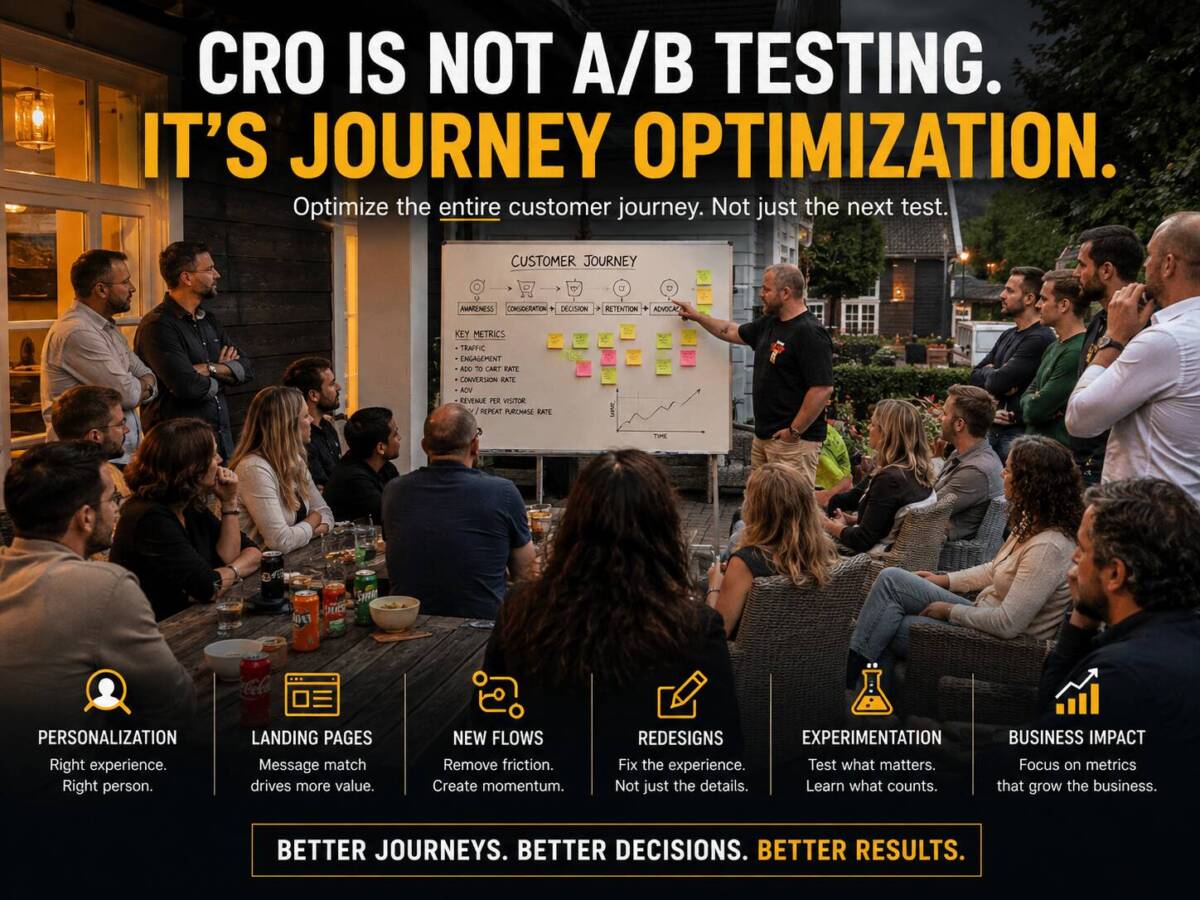
CRO needs to move beyond the click
This is the part I find most interesting as someone who has spent much of his career working in CRO, UX and growth.
We’ve spent years becoming exceptionally good at optimizing interfaces.
But optimization has always been about something deeper than button colors and page layouts.
The real job is:
Understanding what prevents a decision from happening and systematically removing that friction.
When the decision-maker is a human, that friction might be uncertainty, cognitive overload or poor usability.
When an AI agent participates in the decision, the friction could be missing product data, ambiguous specifications, inaccessible inventory or information the agent cannot reliably verify.
The interface changes.
The optimization mindset doesn’t.
CRO and SEO may start converging
There is another interesting consequence.
Historically, SEO and CRO were largely separate disciplines.
SEO helped people find the website.
CRO helped them convert once they arrived.
AI starts blurring that boundary.
If an AI assistant is simultaneously discovering products, comparing them and recommending one, then discoverability and conversion become part of the same decision system.
Your product doesn’t simply need to rank.
It needs to be understood.
It doesn’t simply need to be understood.
It needs to be trusted.
And it doesn’t simply need to be trusted.
It needs to be selected.
That means structured data, product information, reputation, pricing, availability, content, UX and conversion strategy increasingly influence the same outcome.
The winning product might not be the one with the highest Google ranking or the prettiest PDP.
It could be the product an AI system can most confidently determine is the right answer.
This also changes experimentation
There is another uncomfortable implication for CRO teams.
A/B testing traditionally measures human behavior.
Variant A versus Variant B.
Which one generates more clicks, purchases, leads or revenue?
But if part of product discovery moves into AI environments, some important optimization decisions happen before the human session even begins.
That means tomorrow’s experimentation programs may need to measure much more than website conversion rate.
For example:
- How frequently are our products recommended by AI systems?
- Which information makes our products easier to correctly classify?
- Are AI-referred visitors behaving differently?
- Which product attributes influence recommendation?
- Where do agents fail to understand our offering?
- Can agents accurately determine availability, compatibility and delivery conditions?
This is a different optimization landscape.
And we’re only at the beginning.
Don’t redesign your entire website for robots yet
There is also a danger of overreacting.
Every major technological shift produces consultants declaring that everything we know is suddenly obsolete.
It isn’t.
People still visit websites.
People still care about brands.
People still want inspiration.
People still make irrational decisions.
People still abandon checkouts because something feels wrong.
Human psychology isn’t receiving a software update.
And not every purchase is suitable for autonomous agents.
The more emotional, expensive, complex or identity-driven a purchase becomes, the more likely humans are to remain deeply involved.
Buying printer paper is very different from buying a €15,000 watch.
So I don’t believe we’re moving from human commerce to agent commerce.
We’re moving toward hybrid commerce.
Sometimes humans will browse.
Sometimes AI will assist.
Sometimes AI will shortlist and humans will decide.
Sometimes agents may execute almost everything.
The customer journey becomes fluid.
The companies that prepare early will have an advantage
This doesn’t require throwing away your current CRO roadmap.
It requires expanding it.
When auditing a digital business today, I would increasingly ask questions such as:
- Can both humans and machines clearly understand what is being sold?
- Is important product information structured or buried inside presentation?
- Are product attributes consistent?
- Can availability and pricing be reliably interpreted?
- Are claims supported by evidence?
- Are policies explicit?
- Does the website perform well when an AI referral lands directly on a deep product page?
- Is the brand still persuasive when the traditional browsing journey disappears?
And perhaps most importantly:
If an AI agent had to choose between your product and your competitor’s product today, would you understand why it chose one over the other?
Most companies couldn’t answer that question yet.
The next evolution of optimization
I don’t think AI kills CRO.
I think it exposes how narrow our definition of CRO became.
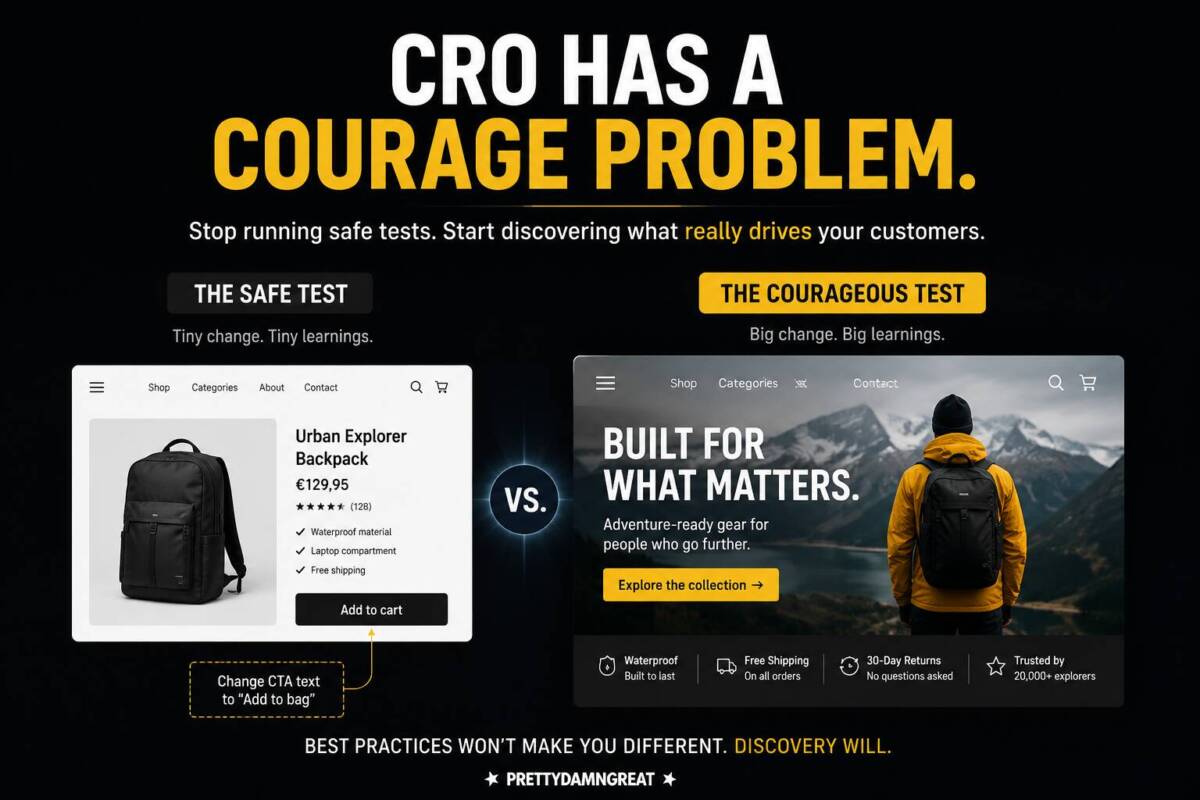
Conversion optimization was never supposed to mean moving buttons around until a dashboard turns green.
It is the systematic practice of understanding decisions, identifying friction and improving the probability of a valuable outcome.
For the last twenty years, that mostly meant optimizing websites for humans.
The next twenty may require us to optimize digital businesses for both humans and machines.
UX isn’t disappearing.
CRO isn’t disappearing.
The customer isn’t disappearing.
But the entity influencing the customer’s decision is changing.
And your next customer might not be the one clicking the button.
Is your digital experience ready for what comes next?
At PrettyDamnGreat, I help businesses identify conversion barriers, improve customer journeys and turn behavioral insights into measurable growth through CRO, UX and experimentation.
If you’re wondering where your website, e-commerce experience or experimentation program is leaving growth on the table, let’s talk.