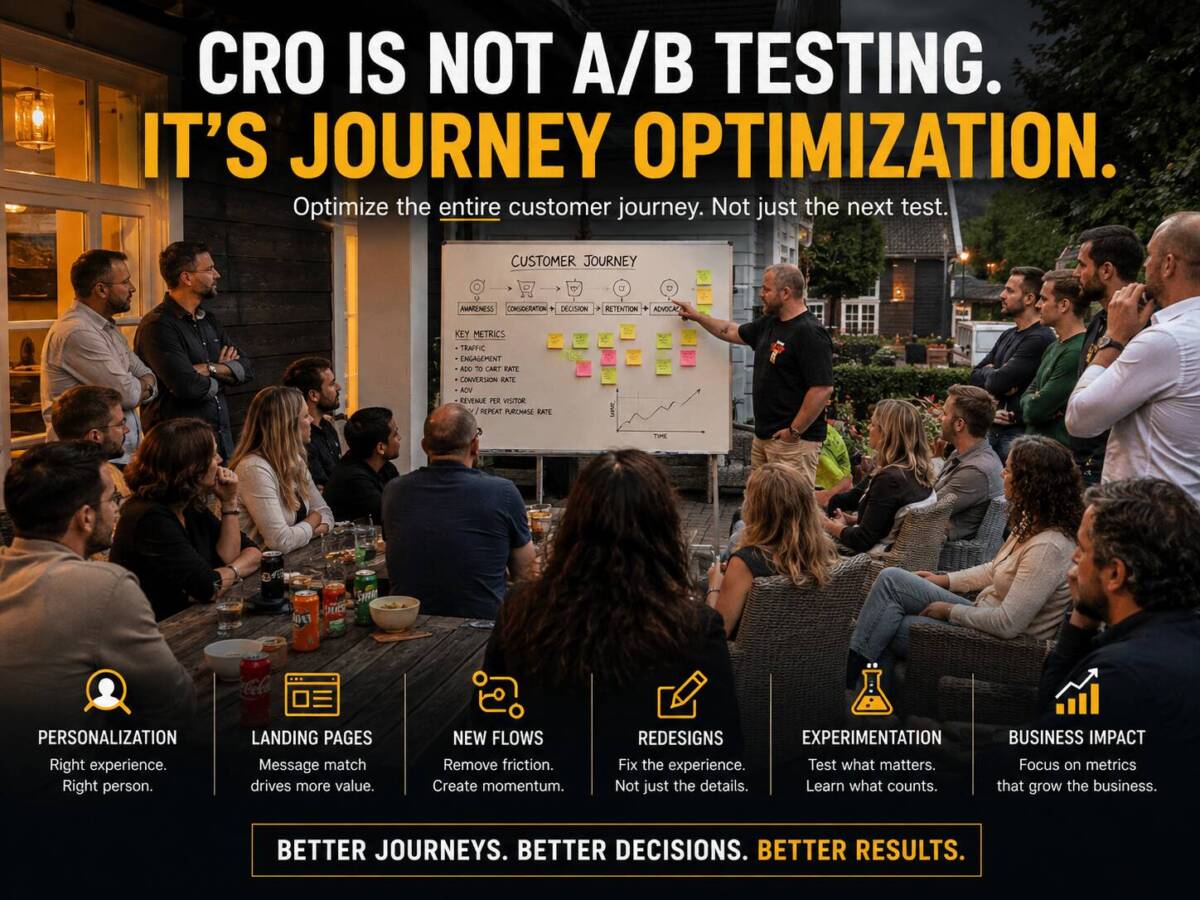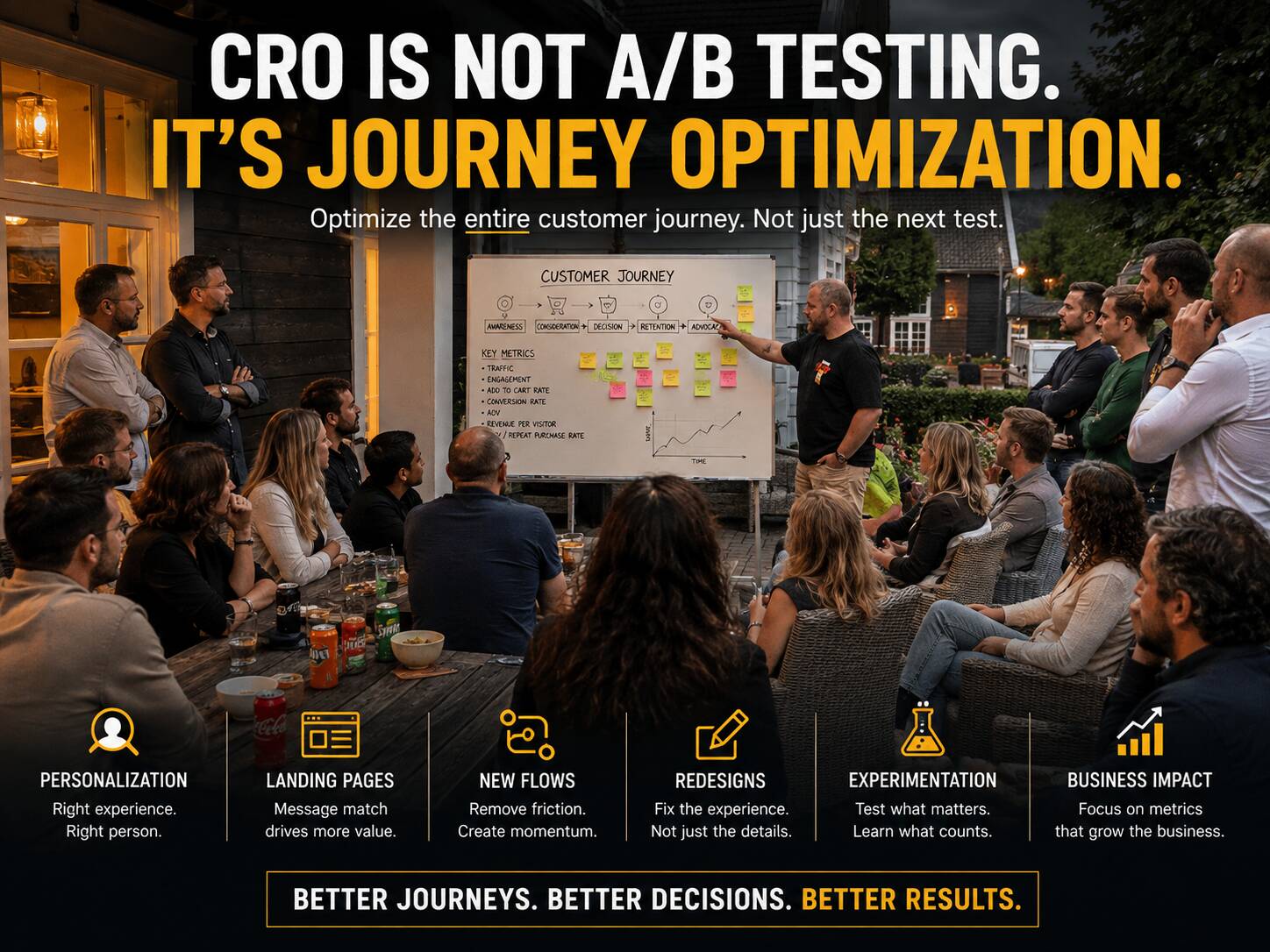
Conversion Rate Optimization is not just experimentation. Mature CRO improves the complete customer journey by combining data, psychology, UX, personalization, landing pages, funnel optimization, new flows, redesigns and A/B testing to improve meaningful business metrics.
Somewhere along the way, Conversion Rate Optimization became almost synonymous with A/B testing.
How many experiments did we launch?
How many reached statistical significance?
How many won?
What was the uplift?
Those are important questions.
But if that is the entire CRO program, we are reducing a broad optimization discipline to a single methodology.
Testing is something CRO does. It is not what CRO is.
What is Conversion Rate Optimization?
Conversion Rate Optimization, or CRO, is the systematic improvement of a digital customer journey to increase valuable customer actions and business outcomes.
Those outcomes can include much more than conversion rate itself:
- Revenue per visitor
- Average order value
- Checkout completion rate
- Lead quality
- Product discovery
- Customer acquisition efficiency
- Subscription adoption
- Repeat purchase rate
- Customer lifetime value
- Margin
- Engagement with strategically important products or services
A/B testing is one of the most powerful tools available to CRO teams, but it is only one tool.
A mature CRO program can also include:
- Customer research
- Web analytics
- Behavioral analysis
- UX research
- Personalization
- Audience segmentation
- Custom landing pages
- New customer flows
- Website and funnel redesigns
- Content optimization
- Value proposition development
- Checkout optimization
- Technical improvements
- Journey orchestration
And sometimes the correct CRO recommendation is simply:
Fix it.
CRO is optimization, not testing
The clue is literally in the name:
Conversion Rate Optimization.
Not Conversion Rate Testing.
The objective is to improve the performance of the customer journey.
Experimentation can help determine whether an intervention causes an improvement, but experimentation should serve optimization.
Optimization should not exist merely to feed an experimentation program.
If analytics shows that a large percentage of mobile customers encounter a technical error during checkout, it makes little sense to deliberately expose half of your traffic to the broken experience purely because your CRO process requires an A/B test.
Fix the problem.
Use experimentation where meaningful uncertainty exists.
Stop optimizing pages. Start optimizing customer journeys.
One limitation of test-driven CRO is that it naturally pushes teams toward individual pages and components:
- Homepage
- Product detail page
- Product listing page
- Navigation
- CTA
- Cart
- Checkout
But customers do not experience websites as isolated page templates.
Customers experience journeys.
A customer might:
- Discover your company through Google.
- Land directly on a product page.
- Compare several alternatives.
- Leave without buying.
- Return through an email campaign.
- Read customer reviews.
- Complete the purchase on mobile three days later.
Another visitor may arrive through paid social with no previous brand awareness.
A returning customer may already know exactly what they want and simply need the fastest possible path to purchase.
Those are completely different customer contexts.
Yet many businesses send all of them through essentially the same digital experience.
Then CRO arrives and changes the button.
We are optimizing the tree while ignoring the forest.
The entire conversion funnel should be optimized
Good CRO looks at the complete path from customer intent to commercial outcome.
A CRO specialist should ask:
- Where do customers enter the journey?
- What do they expect when they arrive?
- What information do they need next?
- Where does uncertainty appear?
- Where does motivation increase?
- Where does motivation disappear?
- Which steps create unnecessary friction?
- Where are customers forced backwards?
- Which audience segments behave differently?
- Which decisions are unnecessarily difficult?
- Where does the business lose high-value customers?
This also means looking beyond conversion rate.
The goal of CRO is not simply to increase one percentage. The goal is to improve the economics of the customer journey.
A higher conversion rate combined with dramatically lower margin is not necessarily optimization.
More leads combined with significantly lower lead quality may not be optimization either.
A higher add-to-cart rate combined with worse checkout completion can even indicate that friction has simply moved elsewhere in the funnel.
Sometimes CRO should create a completely new customer flow
Many CRO programs inherit an existing funnel and immediately begin optimizing it.
Step 1.
Step 2.
Step 3.
Step 4.
Each step becomes slightly better.
But sometimes the biggest CRO opportunity is not improving Step 3.
It is asking:
Why does Step 3 exist at all?
Perhaps customers should not need to navigate through multiple category pages before discovering the right product.
Maybe they need a guided product finder.
Perhaps a complex quotation funnel does not need better microcopy.
Maybe the entire quotation journey needs to be redesigned.
Perhaps every marketing campaign should not land on the same generic website.
Maybe different customer intents require completely different landing experiences.
Sometimes CRO improves an existing journey. Sometimes CRO designs a better journey.
Personalization is Conversion Rate Optimization
Personalization is CRO because it improves the relevance of the customer experience based on audience, behavior, context or intent.
Consider two visitors.
Visitor A is visiting your website for the first time.
Visitor B has visited six times, repeatedly viewed the same product category and has previously purchased from your company.
Why should they automatically see exactly the same homepage?
Or imagine a software company.
One visitor is a freelancer.
Another visitor is the procurement manager of a multinational organization.
They may currently receive:
- The same proposition
- The same navigation
- The same proof
- The same case studies
- The same CTA
- The same customer journey
Operationally, that may be convenient.
Commercially, it may be far from optimal.
Different intent deserves different experiences.
Personalization changes the CRO question from:
“Which version converts better?”
to:
“Which experience works best for which customer?”
Custom landing pages are part of CRO
Marketing teams invest heavily in generating traffic through:
- Paid search
- Paid social
- Email marketing
- Influencers
- Affiliates
- Partnerships
- Display advertising
- Offline campaigns
- Organic search
Yet many businesses send these completely different audiences to the same handful of generic pages.
That creates an obvious CRO opportunity.
If someone clicks an advertisement about a specific customer problem, product category, proposition or audience, the landing page should continue that conversation.
A strong landing page can align:
- Customer intent
- Campaign promise
- Value proposition
- Audience
- Problem
- Solution
- Proof
- Call to action
Message match is conversion optimization.
CRO should therefore not only optimize existing landing pages.
CRO can identify when a dedicated landing page should exist in the first place.
Website redesigns can be CRO too
There is sometimes unnecessary tension between CRO and redesign projects.
CRO specialists correctly warn that large redesigns make it difficult to isolate which individual change caused a performance difference.
That is statistically true.
But there are situations where incremental optimization becomes commercially absurd.
If the information architecture is fundamentally wrong, do not spend two years testing your way toward a redesign one navigation item at a time.
If the website no longer communicates the proposition correctly, rethink the experience.
If customer research reveals that the entire journey is based on the wrong mental model, redesign it.
If mobile has effectively inherited a desktop journey that does not match mobile behavior, rethink the mobile experience.
A mature CRO program should help shape redesigns using:
- Behavioral data
- Customer research
- UX research
- Analytics
- Previous experimentation
- Customer psychology
- Commercial insight
After launch, the optimization cycle continues:
Measure → Analyze → Experiment → Improve
CRO should not stand next to a redesign waiting for permission to test button colors afterwards.
CRO should help determine what gets redesigned and why.
CRO connects data, UX, psychology, marketing and product
This is where senior CRO becomes particularly valuable.
Conversion optimization sits between several disciplines.
Data
What is happening?
Analytics, funnels and behavioral data reveal where performance changes, where customers drop out and where opportunities may exist.
UX
Where is the experience creating friction?
UX research helps uncover usability problems, information architecture issues and interaction barriers.
Psychology
Why are people behaving this way?
Behavioral science can help explain motivation, hesitation, trust, cognitive load, perceived risk and decision-making.
Marketing
What expectation brought the customer here?
Campaigns, propositions and acquisition channels strongly influence what users expect when they enter the journey.
Product
What are we asking customers to use, choose or purchase?
Sometimes the conversion problem is not the interface. It is the proposition, product or decision architecture itself.
Technology
What can we build, automate and personalize?
Technology determines which experiences, customer flows and personalization strategies are realistically possible.
Commercial strategy
Which customer behaviors actually create business value?
The highest conversion rate is not automatically the best commercial outcome.
Experimentation
How can we validate uncertainty?
Experimentation connects hypotheses to causal evidence and helps separate opinion from actual customer behavior.
Not every CRO improvement needs an A/B test
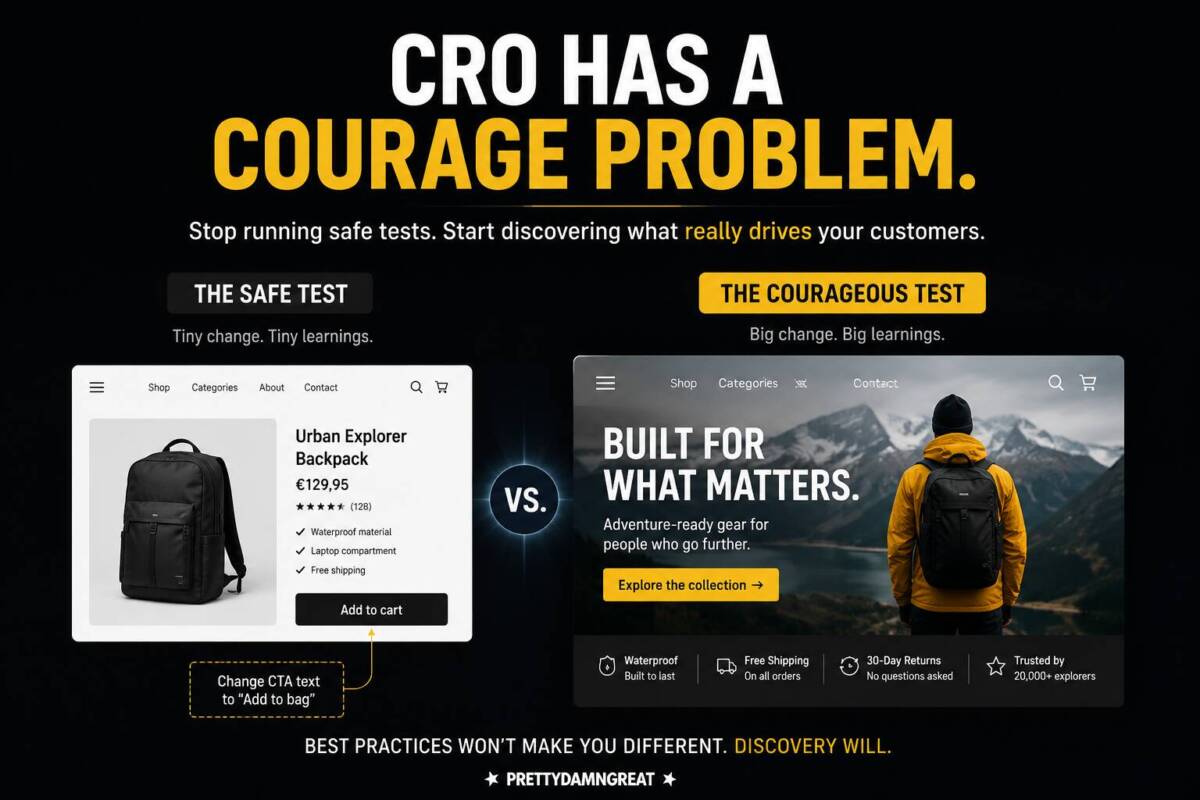
This may sound strange after arguing that CRO teams should have the courage to run meaningful experiments.
But mature experimentation also requires knowing when not to test.
Every experiment has a cost:
- Development resources
- Design resources
- Traffic
- Time
- Statistical capacity
- Organizational attention
Before launching an experiment, ask:
Is there meaningful uncertainty here?
If analytics, customer complaints, session recordings and usability research all show the same severe usability problem, another eight-week A/B test may add little value.
Fix the issue.
Save experimentation capacity for questions where the answer genuinely is not obvious.
CRO should build solutions, not just evaluate them
This is one of the biggest distinctions between narrow experimentation and mature conversion optimization.
A CRO specialist should not only be able to tell an organization:
“Variant B won.”
They should be able to say:
“Here is where the business is losing customers, here is why I believe it is happening, and here is what we should do about it.”
Sometimes that answer is an experiment.
Sometimes it is personalization.
Sometimes it is a custom landing page.
Sometimes it is a new navigation structure.
Sometimes it is a completely new flow.
Sometimes it is a redesign.
Sometimes it means removing something.
Sometimes it means creating something that did not exist before.
CRO should create solutions, not just evaluate them.
Build an optimization roadmap, not only an experimentation roadmap
This distinction changes how a CRO roadmap should be structured.
Instead of starting with:
“Which 20 tests are we running this quarter?”
Start with:
“Where are the biggest opportunities in the customer journey?”
Then determine the appropriate intervention.
For example:
- An opportunity may become an A/B test.
- Another may require customer research first.
- Another may become a personalized experience.
- Another may require a dedicated landing page.
- Another may require a technical fix.
- Another may become a redesign project.
- Another may require a completely new customer flow.
The roadmap should be organized around opportunities and outcomes, not around a predetermined solution called testing.
Measure the customer journey, not just experiment uplift
Of course CRO teams should measure experiment results.
But mature CRO measurement should go further.
Ask:
- Did more customers discover the right product?
- Did qualified engagement improve?
- Did customers progress through the funnel faster?
- Did support demand decrease?
- Did checkout abandonment decrease?
- Did average order value increase?
- Did revenue per visitor improve?
- Did lead quality improve?
- Did first-time customers return?
- Did one metric improve while another important metric deteriorated?
A mature CRO program creates a measurement framework around the complete customer journey, not just a dashboard containing A/B-test uplifts.
Experimentation is the engine, not the destination
None of this makes A/B testing less important.
Experimentation remains one of the most valuable tools in conversion optimization because it helps separate what we believe from what actually changes customer behavior.
I want bold experiments.
I want hypotheses to be challenged.
I want significant results.
I want winners.
And occasionally I want hypotheses to fail spectacularly because those failures can reveal something important about customers.
But the hierarchy matters:
Experimentation should serve optimization.
Optimization should not serve experimentation.
Mature CRO is customer journey optimization
This is ultimately why the debate about whether Conversion Rate Optimization is still the correct title does not concern me very much.
You can rename the discipline.
The more important question is:
What responsibility do you give it?
If CRO means:
“The people who run A/B tests.”
Then yes, that definition is too narrow.
But mature CRO is much broader.
CRO is the discipline responsible for finding opportunities throughout the digital customer journey and turning those opportunities into measurable business improvement.
That can happen through:
- Research
- Data
- Psychology
- Experimentation
- Personalization
- Audience segmentation
- Custom landing pages
- New customer flows
- UX optimization
- UI improvements
- Redesigns
- Technical improvements
- Commercial optimization
And sometimes it simply means fixing something that should never have been broken in the first place.
The A/B test is one tool in the CRO toolbox.
A very powerful one.
But nobody hires a carpenter because they are exceptionally good at using a hammer.
They hire them to build something.
CRO should be no different.
Don’t just test the customer journey. Optimize it.
If your CRO program is measured primarily by the number of experiments it launches, it may be time to zoom out.
Look at the entire customer journey.
Find the biggest commercial opportunities.
Understand customer behavior.
Identify friction.
Improve relevance.
Create better journeys.
Use experimentation where uncertainty needs to be resolved.
And measure whether the business actually improves.
That is Conversion Rate Optimization.
Frequently Asked Questions about CRO
Is CRO the same as A/B testing?
No. A/B testing is one methodology used within Conversion Rate Optimization. CRO also includes customer research, analytics, UX optimization, personalization, landing pages, funnel improvements, new customer flows, redesigns and other interventions designed to improve customer and business outcomes.
What does a CRO specialist optimize?
A CRO specialist can optimize the entire digital customer journey, including acquisition landing pages, navigation, product discovery, product pages, checkout, lead funnels, personalization, customer flows and post-purchase experiences.
Does every CRO change need to be A/B tested?
No. When there is meaningful uncertainty about an intervention, experimentation can provide valuable causal evidence. But obvious technical errors, severe usability issues or well-supported problems may be better fixed directly.
Is personalization part of CRO?
Yes. Personalization is part of CRO because it aims to provide a more relevant experience based on customer segment, behavior, context or intent, with the objective of improving measurable customer and business outcomes.
Are landing pages part of Conversion Rate Optimization?
Yes. Dedicated landing pages can improve message match between an acquisition campaign and the customer’s destination experience. Creating and optimizing these pages is an important CRO activity.
Can website redesigns be part of CRO?
Yes. CRO research, analytics and experimentation can identify when incremental improvements are no longer sufficient and a larger redesign is justified. CRO should help shape the redesign and continue measuring and optimizing the experience after launch.
What metrics should CRO improve?
CRO can improve conversion rate, but mature programs also consider revenue per visitor, average order value, checkout completion, lead quality, margin, customer acquisition efficiency, repeat purchase behavior and customer lifetime value.
Need to optimize more than individual A/B tests?
At PrettyDamnGreat, I work across the complete customer journey, combining CRO, UX, behavioral insights, experimentation, personalization and digital strategy to identify and implement opportunities that drive measurable growth.
If your organization needs more than another list of experiments, let’s look at the journey behind them.