Why mature companies should stop blindly following CRO best practices and start discovering what makes their own customers different.
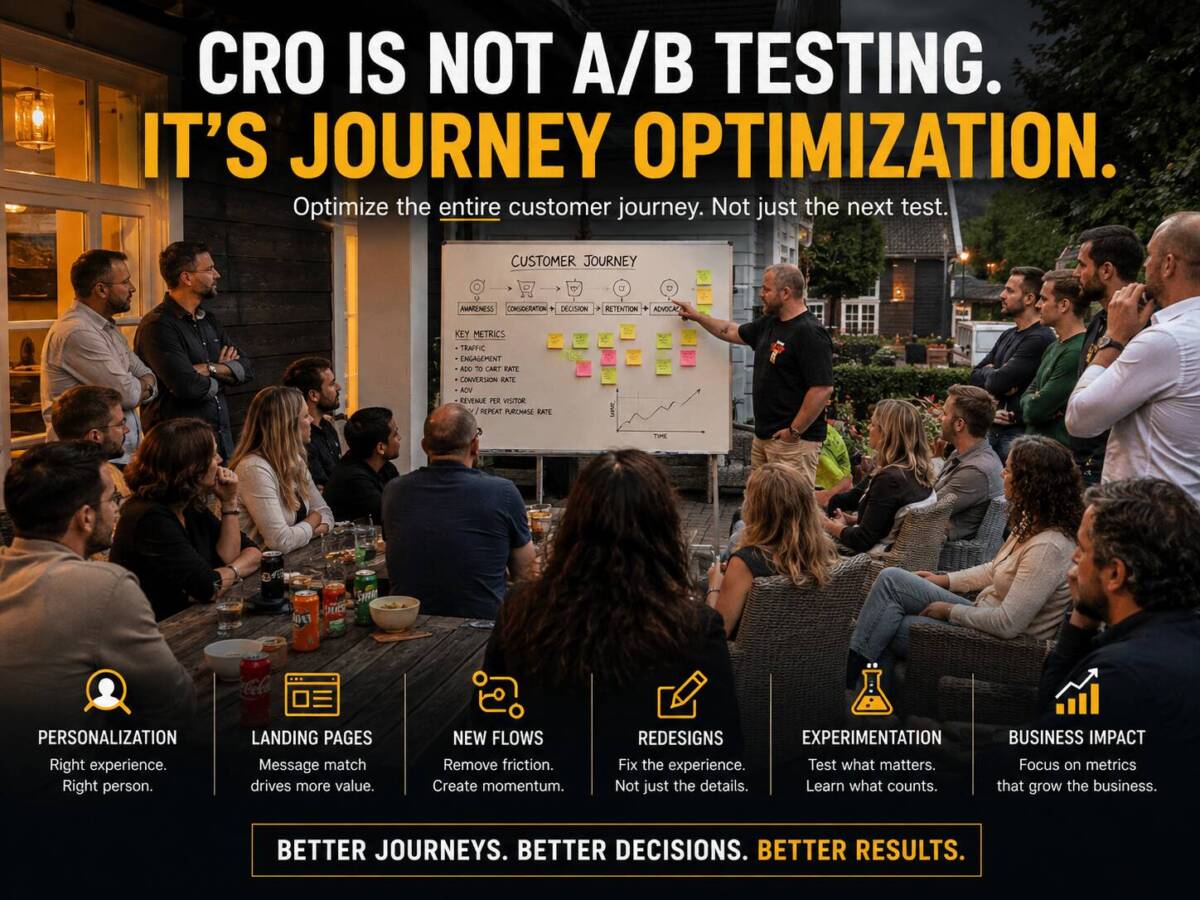
I keep seeing CRO specialists explain what’s wrong with CRO.
The title is wrong.
Conversion rate is the wrong metric.
A/B testing is too narrow.
CRO should become experimentation.
Experimentation should become growth.
Growth should become product optimization.
Maybe.
But before we rename the discipline for the fifth time, I think we should ask a much more uncomfortable question:
Are we actually doing CRO properly?
Because after working in CRO, UX and digital growth for many years, I don’t think the biggest problem is the name.
I don’t even think the methodology is the problem.
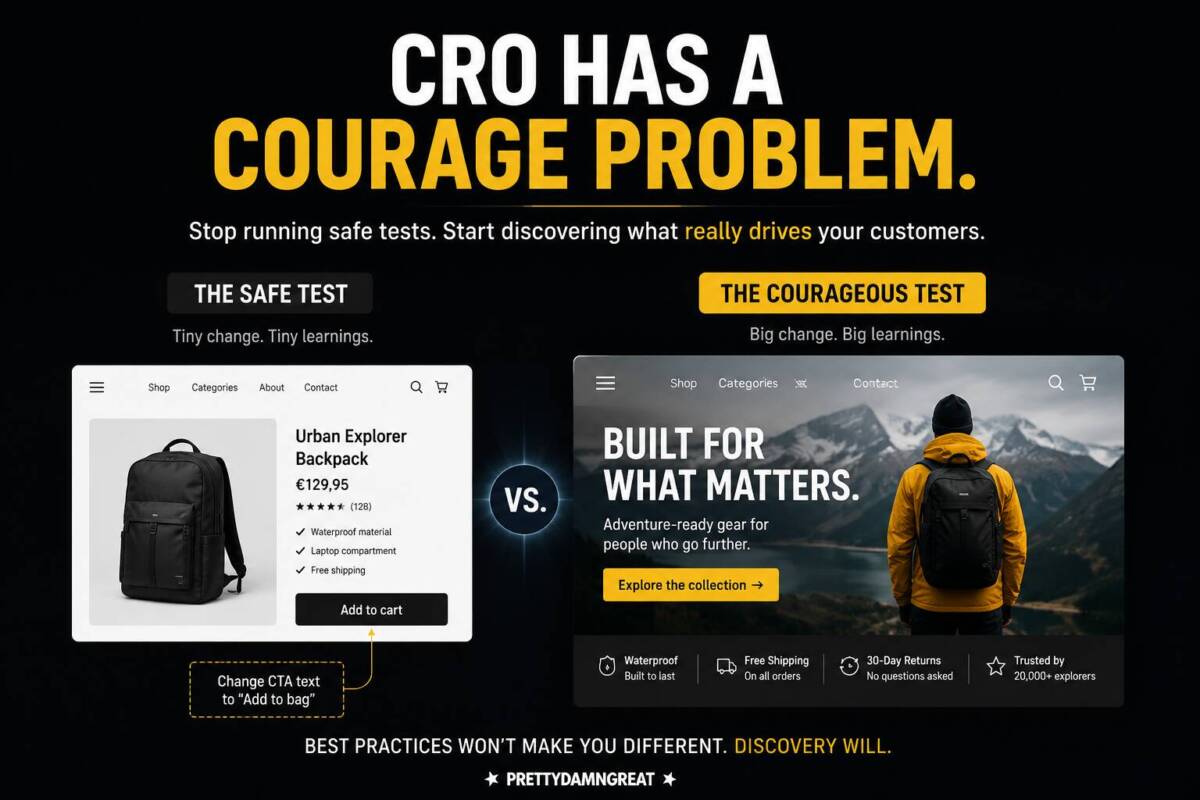
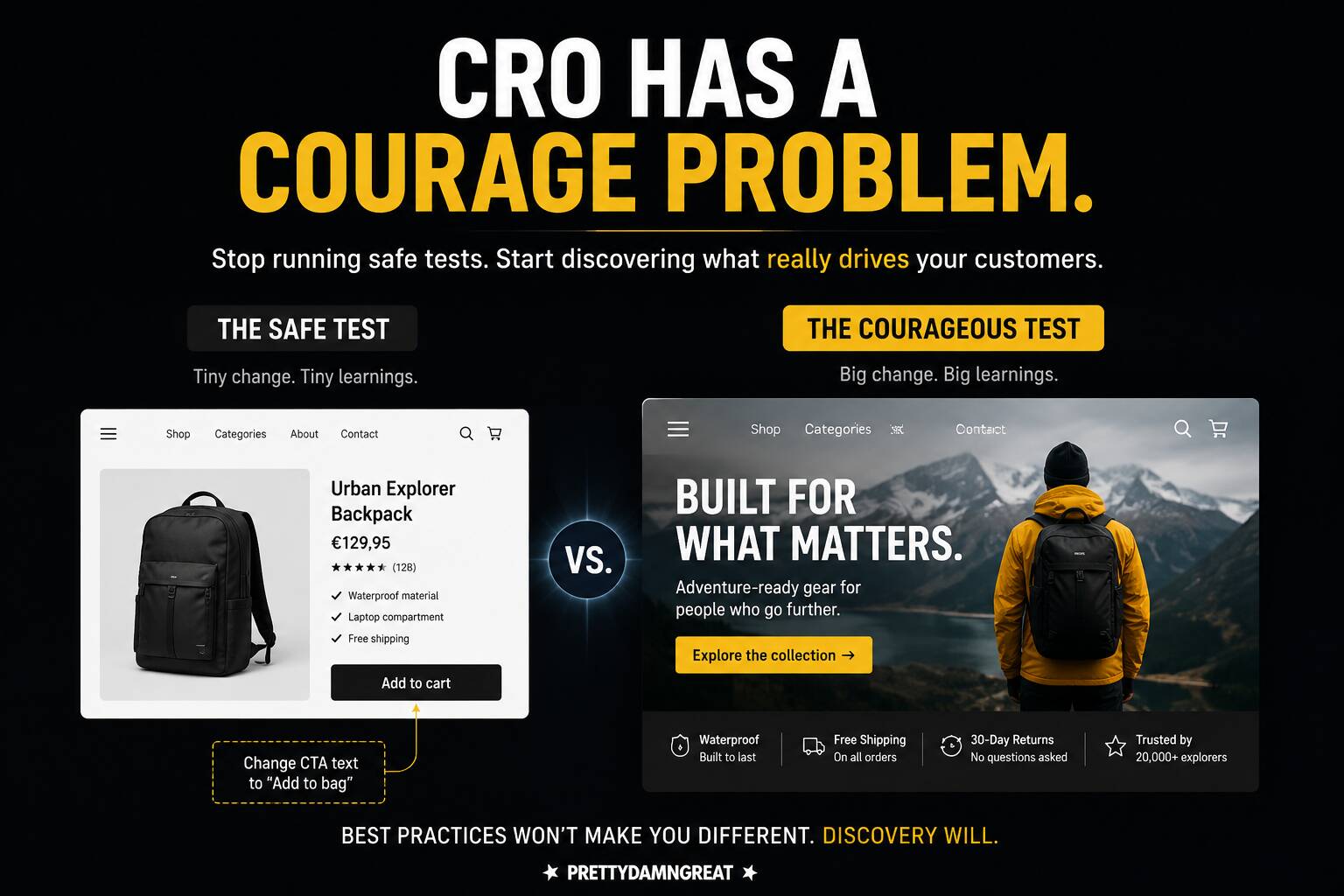
I think a lot of companies simply don’t have the courage to experiment.
They test.
But they don’t really experiment.
And there is a difference.
Most experimentation isn’t experimentation
Look at the average CRO backlog and you’ll probably recognize some of these:
- Move the USPs higher.
- Make the CTA sticky.
- Change the CTA copy.
- Add reviews underneath the product title.
- Reduce the number of checkout fields.
- Add urgency.
- Increase the contrast of a button.
- Move delivery information closer to the CTA.
- Add social proof.
None of these ideas are necessarily bad.
I’ve tested variations of many of them myself.
The problem starts when this becomes the entire experimentation strategy.
Because at that point, you’re not really trying to discover something.
You’re optimizing around things the industry already largely believes to be true.
Worse, in many organizations the CRO roadmap is slowly becoming another way to launch the product backlog.
Product wants feature X.
Marketing wants proposition Y.
UX wants redesign Z.
Instead of implementing it directly, somebody says:
“Let’s A/B test it.”
The experiment then becomes a soft launch with statistics attached.
That’s validation.
It can be useful.
But don’t confuse it with discovery.
Real experimentation starts where certainty ends.
The Safe Test Trap
This is where many experimentation programs get stuck.
Companies say they want experimentation.
But simultaneously they want to minimize:
- Revenue risk
- Brand risk
- Development effort
- Design deviation
- Stakeholder disagreement
- Negative test results
- Internal politics
So an interesting hypothesis enters the organization and slowly gets watered down.
Maybe research suggests that customers don’t understand the proposition.
The original idea might be:
Completely restructure the page around the customer’s primary buying motivation.
Then the meetings begin.
Brand wants to keep the hero.
Product wants to preserve the current structure.
Design doesn’t want to deviate from the design system.
Marketing needs three campaigns to remain visible.
SEO doesn’t want the copy to change too much.
Development wants to minimize complexity.
By the time everyone has approved the experiment, the variant looks almost identical to the control.
Perhaps a USP moved 100 pixels upward.
Then the experiment runs.
Nothing happens.
And everyone concludes:
“CRO doesn’t really move the needle anymore.”
No.
You didn’t move the experience enough to expect the customer to move either.
You cannot simultaneously minimize the difference between control and variant and maximize your chances of discovering a meaningful difference in behavior.
Best practices are useful. Until they become your strategy.
CRO best practices have value.
Especially when a company is relatively immature.
If your checkout is confusing, your mobile website barely works, your value proposition is invisible and users can’t find your CTA, you probably don’t need revolutionary experimentation.
Fix the fundamentals.
There is no medal for A/B testing an obviously broken experience.
But something should change as the organization matures.
Once you’ve implemented the obvious improvements, continuing to copy CRO best practices produces diminishing returns.
Because your competitors have read the same articles.
They use the same research.
They follow the same UX patterns.
They benchmark the same market leaders.
And increasingly, they’re asking the same AI models for optimization ideas.
Think about where that leads.
Your competitor asks:
“What are the best practices for an e-commerce PDP?”
You ask the same question.
You both receive:
- Clear product imagery
- Prominent CTA
- Reviews
- Delivery information
- Trust signals
- Sticky add-to-cart
- Clear returns
- Social proof
- Scarcity
Congratulations.
You’ve both optimized yourselves toward the same website.
Benchmarking can make you average
Benchmarking feels sophisticated because it looks like research.
Sometimes it is.
But benchmarking can also become intellectual laziness.
A competitor does something.
You assume they know something you don’t.
So you copy it.
But you don’t know why they implemented it.
You don’t know whether they tested it.
You don’t know whether it won.
You don’t know whether their customers behave like yours.
You don’t know whether their business model makes the same trade-offs.
You might literally be copying their losing experiment.
This is why I use competitors primarily to understand the landscape, not to determine the answer.
I want to know what customers are accustomed to.
I want to understand category conventions.
I want to identify gaps.
But the most interesting question isn’t:
“What are our competitors doing?”
It’s:
“What do we understand about our customers that our competitors don’t?”
That’s where competitive advantage starts.
Your niche is where the golden nuggets are hiding
Mature CRO shouldn’t gradually become more generic.
It should become increasingly specific.
Specific to your customers.
Specific to your proposition.
Specific to your economics.
Specific to your category.
Specific to your brand.
Specific to the psychological reasons people choose you instead of someone else.
That’s where the golden nuggets live.
Maybe your customers aren’t primarily price-sensitive, even though everyone internally assumes they are.
Maybe delivery certainty matters significantly more than delivery speed.
Maybe your premium customers actually convert better when you remove discounts.
Maybe showing fewer choices increases average order value.
Maybe your customers care about compatibility much more than specifications.
Maybe the ugly version of your product page converts significantly better because it communicates expertise.
Maybe removing a popular feature improves conversion because the feature creates uncertainty.
Maybe the message your brand team dislikes is exactly the message your customers need.
You won’t discover these things by searching:
“CRO best practices 2026.”
You discover them by studying your own audience and having the courage to test what you find.
Stop asking what you should test
One of the most common questions in CRO is:
“What should we test next?”
I think that’s usually the wrong starting point.
The better question is:
“What don’t we understand about our customers yet?”
That’s a completely different conversation.
- Why do customers choose us?
- Why do others choose our competitors?
- What creates hesitation?
- What makes someone willing to pay more?
- Which information changes purchase intent?
- What do customers misunderstand?
- Which assumptions inside the company have never actually been validated?
- What separates high-value customers from everyone else?
- Why do people who love the product love it?
Now experimentation becomes a tool for answering business questions.
And your test backlog changes from a collection of interface ideas into a collection of beliefs waiting to be challenged.
Stop testing interfaces. Start testing beliefs.
Suppose customer research suggests:
Customers aren’t buying because they don’t understand why this product costs 30% more than alternatives.
You could test:
“Move the USP section upward.”
That’s technically an experiment.
But it barely tests the underlying belief.
A stronger experiment might completely restructure the product page around value justification.
- Show the material differences.
- Explain durability.
- Visualize cost over time.
- Compare ownership value.
- Bring proof much closer to price.
- Change the information hierarchy.
Make the entire experience answer one question:
“Why is this worth paying more for?”
Now we’re testing something meaningful.
If conversion increases significantly, we’ve learned something about the customer’s decision.
If conversion drops significantly, we’ve also learned something.
If nothing happens, that tells us something too.
The important thing is that the experiment had enough contrast to challenge our assumption.
Dare to create distance between A and B
This is where I think many CRO programs are too conservative.
The goal isn’t to make Variant B slightly better than Variant A.
The goal is to create the right amount of contrast to test the hypothesis.
Sometimes that means changing one sentence.
Sometimes it means changing half the page.
Sometimes it means removing something everyone considers essential.
Sometimes it means introducing something that stakeholders initially dislike.
The size of the change should follow the hypothesis.
Not organizational comfort.
Hardcore CRO doesn’t mean testing crazy things. It means being willing to test consequential hypotheses.
There should be a reason behind the risk.
- Research
- Behavioral data
- Customer interviews
- Analytics
- Usability studies
- Previous experiments
- Commercial insight
But once the evidence points somewhere interesting, have the courage to follow it.
Statistical significance isn’t the same as success
Across my own experimentation work, roughly 80% of my tests reach statistical significance, with an overall success rate of approximately 66%.
I’m proud of those numbers.
But I don’t think every CRO specialist should target a 66% win rate.
In fact, that could create exactly the wrong incentive.
If you reward an experimentation team purely for winners, they’ll eventually learn to protect their win rate.
They’ll choose safer experiments.
Smaller experiments.
Obvious improvements.
Ideas stakeholders already support.
And eventually you’re back to the Safe Test Trap.
What interests me more is whether experiments consistently produce decisive learning.
A significant positive result is valuable.
A significant negative result can be extremely valuable.
Imagine discovering that a €500,000 product initiative actually reduces customer intent before you’ve rolled it out.
That’s a successful experiment.
The variant lost. The company won.
An insignificant test can be useful too
There is an important nuance here.
Not every experiment needs to move conversion.
Sometimes discovering that something doesn’t matter is valuable.
But if test after test after test produces no measurable movement whatsoever, I wouldn’t immediately conclude:
“Our customers are impossible to influence.”
I’d look upstream.
- Are the hypotheses strong enough?
- Is the research good enough?
- Are the interventions large enough?
- Are we testing meaningful customer problems?
- Do we have sufficient traffic and statistical power?
- Or are we simply rearranging the furniture?
A healthy experimentation program shouldn’t be afraid of negative movement.
Flat lines are often more worrying than losses.
At least a meaningful loss tells you that you touched something customers care about.
The biggest wins rarely come from consensus
There is a reason companies struggle with this.
Consensus and experimentation are uncomfortable partners.
Organizations naturally optimize ideas toward internal agreement.
Experimentation exists because we acknowledge that internal agreement isn’t enough.
If twelve intelligent people sit in a meeting and unanimously believe Variant B will outperform Variant A, ask yourself:
Why are we testing it?
Sometimes there are good reasons.
- Risk management
- Measuring impact
- Understanding magnitude
- Guarding against unintended consequences
But the most valuable experiments often live where intelligent people disagree.
One person thinks removing navigation will increase focus.
Another thinks customers will feel trapped.
Great.
Test it.
Marketing thinks aggressive promotional messaging drives conversion.
Brand thinks it damages trust.
Great.
Test it.
Product thinks customers want more choice.
Research suggests they’re overwhelmed.
Great.
Test it.
Disagreement is experimental fuel.
Don’t remove it from the process.
Use it.
Mature companies should graduate from best practices
There is a maturity curve here.
Stage 1: Fix what is broken
- Usability issues
- Technical problems
- Obvious friction
- Accessibility
- Basic trust
- Clear propositions
You don’t need to reinvent conversion optimization yet.
Stage 2: Apply established principles
Use existing CRO knowledge.
Implement proven UX patterns.
Learn from competitors.
Benchmark category leaders.
Build your research and experimentation infrastructure.
Stage 3: Discover what makes your audience different
Now things become interesting.
Stop asking only:
“What works in e-commerce?”
Start asking:
“What works for our customers?”
Build your own body of evidence.
Your own behavioral principles.
Your own customer model.
Your own experimentation knowledge base.
Stage 4: Exploit proprietary customer knowledge
This is where CRO becomes strategic.
You start knowing things competitors don’t.
You know which motivations drive your highest-value customers.
You understand which anxieties matter.
You know which messages change behavior.
You understand where price sensitivity actually begins.
You know when urgency helps and when it damages trust.
You know which segments require completely different experiences.
Now experimentation isn’t copying the market.
It’s creating an advantage over it.
Your experimentation program should become harder to copy
This might be the simplest test of CRO maturity.
Look at your experimentation backlog.
Could I replace your company name with your competitor’s name and keep 80% of the backlog intact?
If yes, you probably have a generic CRO program.
A mature experimentation program should become increasingly difficult to transplant to another company.
Because it’s built around things you’ve learned about your customers.
That’s proprietary knowledge.
And unlike another sticky CTA, competitors can’t simply inspect your website and copy the reasoning behind it.
They can copy the winner.
They can’t copy the hundred experiments that taught you why it won.
That’s your moat.
Find your golden nuggets
Most experiments won’t transform a business.
That’s fine.
You’re looking for the few that can.
One insight might reveal that an entire customer segment has been misunderstood.
One experiment might expose a completely different value proposition.
One losing test might prevent a costly redesign.
One unexpected result might change your pricing strategy.
One customer motivation might become the foundation for twenty future experiments.
Those are the golden nuggets.
But you won’t find many of them if every experiment needs to be safe, predictable and stakeholder-approved before it launches.
You need rigor.
You need statistics.
You need research.
You need governance.
But eventually you also need something that’s strangely absent from many CRO frameworks:
Courage.
Courage to question your own assumptions.
Courage to contradict a stakeholder.
Courage to stop copying competitors.
Courage to ignore a best practice when your evidence points elsewhere.
Courage to launch a variant that might lose.
And courage to test something different enough that customers actually have the opportunity to prove you wrong.
CRO isn’t broken
So when I see another discussion about why CRO needs a new name, I don’t get particularly excited.
Call it CRO.
Call it experimentation.
Call it growth optimization.
Call it whatever you want.
The title isn’t going to save a mediocre experimentation program.
Better experimentation will.
Stop treating your CRO roadmap as a safe deployment queue.
Stop endlessly benchmarking competitors.
Stop implementing every best practice you find.
Once your company has reached sufficient maturity, those things become the baseline.
Your competitive advantage starts where the best-practice checklist ends.
Study your niche.
Understand your customers better than your competitors do.
Find the beliefs inside your organization that nobody has properly challenged.
Design experiments capable of proving those beliefs wrong.
Take calculated risks.
Accept losses.
Follow unexpected results.
And when the evidence points somewhere nobody else in your category is looking:
Go there.
That’s where the golden nuggets are.
Want to make your CRO program harder to copy?
At PrettyDamnGreat, I help companies move beyond generic optimization by combining customer research, experimentation, UX and conversion strategy to uncover what actually drives behavior.
If your experimentation backlog looks suspiciously similar to your competitors’, it may be time to stop benchmarking and start discovering.